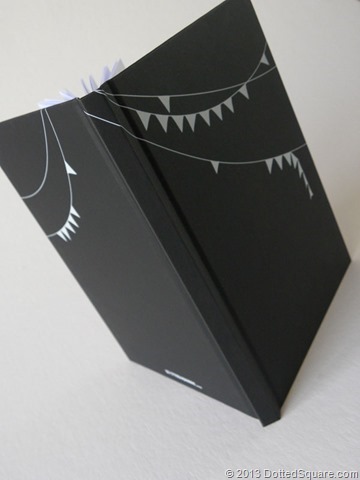
Carnival design wraps around the front and back covers – very limited copies available.
Visit the website for more details.

Carnival design wraps around the front and back covers – very limited copies available.
Visit the website for more details.
What’s more comforting than friendships…
More information on this new product is on the website. A very limited number of copies available.

We love Autumn. :D
Autumn promotion starts today with a 10% savings on selected sheep designs, until 19 March 2013.

Just completed this…
It’s quite easy. Read on.

The design was drawn on the computer and printed on overhead transparencies (see next photo)


Cutting the stencil. This is a laborious process so do take your time. I cut this in a few sittings, getting up in between to do something else. That works for me because when I get tired, I make mistakes.

Stencilling onto the book cover. I used white acrylics paint. Again, slow is good, and keep lifting the stencil to see if you have got enough paint on the design. I used the (almost) dry brush method (as the name suggests, no water and very little paint each time I dabbed my brush onto the surface), but a foam roller will also work well.

I made another 2 bits of stencil for the cup cakes above. All done!
In Part 1, I made the internal pages of the book. In this section, I will show you some work-in-progress pictures of the cover, and of course the final product.
By the way, I have left the completed pages under a pile of heavy books (you can use phone books) to flatten, while I went shopping.
I went to Melbourne Etching Supplies, and they have a number nice bookbinding cloth to choose from. I settled for a green/purplish one which cost below $20 per meter, including GST (a meter of material is enough for many books, since it is very wide – about 4 feet).
Leaving the cover material aside, back home, I used a matt board (acid free) and cut out the front and back covers – slightly bigger than the paper (about 0.5 cm on all sides). I measured the thickness of the internal pages and then cut the spine. (If you find that the size of the boards are too dissimilar of crooked, you can use a sandpaper to make corrections.)
Next place the boards on the cloth and cut out a piece, leaving about 2.5 cm around the outside (see photo on the left). Then draw the cover on the inside leaving about 0.1 cm space on the left and right of the spine (this will allow the book cover to fold nicely), as a guide for the next stage (gluing the boards to the cloth)
The lined boards should look something like the above photo. Glue the boards to the cover material. Ensure the glue covers the entire contact surfaces, not just the edges of the boards. (During this stage, have lots of clean white papers handy and clean along the way if any glue goes astray!)
Turn to the other side. Smooth down to sure that there is no air bubble trapped. At this stage, I placed a few big books to weigh down the cover for a few hours till the glue dries. This will prevent the boards from curling.
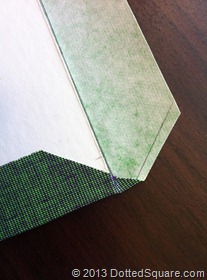
Then cut all 4 corners diagonally, leaving about 0.2 cm space from the corner of the board. Fold the 4 edges and glue.
The inside of your book cover should look something like in the above photo. Next we will tidy up the inside of the cover, as well as stick the pages to the book.
I paste over the inside of the back cover, then score the fold lines of the spine, to help the cover fold neatly.
Then stick page one to the inside front cover and we are done. Here I have placed a stamp on the spine.
The finished book – imperfect but I love that about DIY projects.
Would you have a go?
Here’s another DIY book design.
The steps involved are quite similar to what I did with the text design on cover, except that instead of planning the composition on the computer, I made an initial sketch of the design on a piece of paper. Then I drew the design lightly onto the cover with a soft pencil, then went over with a pigment pen. I have used acrylics and collage for this piece too.
Hope you will have a go at designing your own book covers. You can customise the cover by including your name. It will make a great sketchbook.
Happy creating.
This is a simple way to decorate a plain cover. You can personalise the design for a great gift. Here are some simple steps.
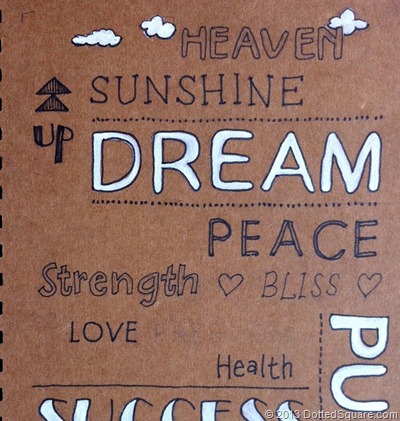
Find a book with a plain cover. Decide on a theme for your design and list words that relates to the theme.
For this design, I laid out the text on my computer to work out the composition and fonts (if you haven’t got access to an application to do that, just use pen or pencil to sketch it out on a rough paper).
Sketch the design lightly with pencil on the cover, and paint some words white.
I used acrylics paint. When the paint is dry, outline all the text with pen.
Note: wait for the paint to dry or your pen/s will be wrecked.
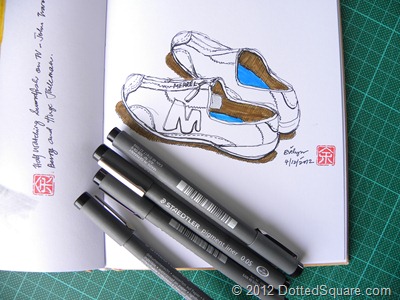
I like to use a variety of pens with different thickness and shades. You may decide to use only a single pen or use coloured pens.
This is roughly where we are up to. There are a lot of gaps to fill in.
Back to the computer – make a list of other words related to your theme in smaller font sizes, and print.
Cut and lay your words on the design, then glue them permanently.
I added some red and it was done. You may want to add other colours.
I put DottedSquare.com’s logo on the back of the book. Don’t forget to sign your name.
I am coming to the end of my second DottedSquare.com journal now, and I am happy to say that the paper used is suitable for a variety of medium. At the initial design stage, various types of papers were tested with watercolour, ink, felt and marker pens etc.
Papers tested at design stage
What is your favourite medium used in your journals and sketchbooks? If you ask me, the answer would vary depending on what I am using at the time since I don’t often stick to one for long.
Here are some mediums that I have used on my DottedSquare.com sketchbooks.
Watercolour and ink with stamps. The paper does not buckle much with light watercolour application. The paper stock is thick enough that both sides of the paper can be used.
In this piece, I used felt pens (Faber Castell artist pens).
Pigment ink and felt pens
And more watercolour.
Right now, I am using watercolour pencils and colour pencils.
What is your experience with DottedSquare.com’s books?
The current deal on DottedSquare.com is a special offer on this journal. And it comes with a free notecard.
The offer only stays around for a few days, so don’t wait too long.